Introduction
For many UK companies, corporation tax is simply seen as a cost of doing business. If your company makes a taxable profit, you pay corporation tax on that profit. It is a familiar part of company accounts, year-end planning, and conversations with your accountant.
But corporation tax is also closely linked to one of the UK’s most valuable innovation incentives: R&D tax relief.
Many business owners search for corporation tax because they want to understand how much they owe, when they need to pay, or whether there are ways to reduce their tax bill. What they may not realise is that if their company has invested in innovation, product development, process improvements, technical problem-solving, or scientific or technological uncertainty, they may be able to reduce their corporation tax bill through R&D tax relief.
Even loss-making companies can receive a cash payment from HMRC.
What is corporation tax?
Corporation tax is paid on the taxable profits of UK limited companies. This can include profits from trading, investments, and selling assets for more than they cost.
The main rate of corporation tax is currently 25% for companies with profits over £250,000. Companies with profits of £50,000 or less pay the small profits rate of 19%, while companies with profits between those limits are entitled to Marginal Relief.
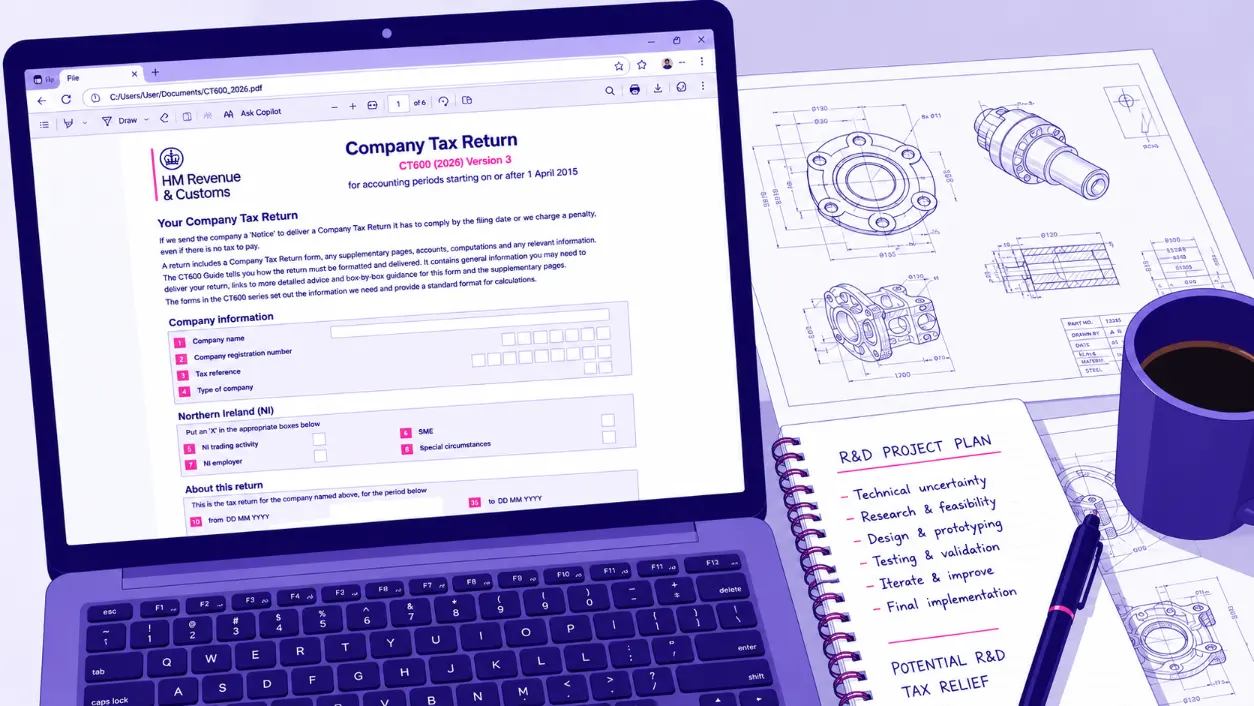
Corporation tax is reported through a Company Tax Return, also known as a CT600. This is where companies report their taxable profit, corporation tax due, and claim any relevant reliefs or credits.
For companies carrying out qualifying research and development, the CT600 is also where R&D tax relief is claimed.
Why corporation tax matters for R&D tax relief
R&D tax relief is a UK government incentive designed to support companies that invest in innovation.
It works through the corporation tax system. That means the relief is only available to companies that are liable for UK corporation tax. Sole traders, partnerships, and LLPs are not eligible because they do not pay corporation tax.
For eligible companies, R&D tax relief can either reduce the amount of corporation tax owed or provide a payable credit where the company is loss-making.
This is where the connection becomes important. Your company does not need to be paying corporation tax right now to benefit from R&D tax relief.
That distinction matters, because many innovative businesses assume they cannot claim if they have not yet made a profit. In reality, loss-making companies do still receive significant support in the form of cash payments when claiming R&D tax credits.
What is R&D tax relief?
R&D tax relief helps companies recover a portion of the costs involved in qualifying research and development activity.
In simple terms, if your company is trying to solve a scientific or technological challenge, and the answer is not readily available, the work may qualify.
This does not only apply to laboratories or software companies. R&D Tax Relief can apply across a wide range of sectors, including manufacturing, engineering, construction, agriculture, software, energy, and many more.
HMRC’s current rules require companies with accounting periods beginning on or after 1 April 2024 to claim under either the merged R&D expenditure credit scheme or Enhanced R&D Intensive Support, also known as ERIS.
The scale of the scheme is significant. HMRC’s September 2025 statistics estimated that £7.6 billion of R&D tax relief support was claimed for the 2023 to 2024 tax year, corresponding to £46.1 billion of qualifying R&D expenditure. 1
How R&D tax relief can reduce corporation tax
R&D tax relief can improve your corporation tax position in different ways, depending on your company’s profitability and the scheme you claim under.
For profitable companies, R&D tax relief can reduce corporation tax by creating a credit or adjustment linked to qualifying R&D expenditure. Under the merged R&D expenditure credit scheme, eligible trading companies can calculate an expenditure credit based on qualifying R&D costs. HMRC guidance explains that the merged scheme credit is calculated at 20% of qualifying R&D expenditure and is taxable as trading income.
For loss-making companies, the position is different. Eligible companies will usually receive a payable credit from HMRC but may also be entitled to carry forward some of their enhanced R&D losses to future years reducing their potential corporation tax bill once they become profitable, depending on the scheme they claim under and their circumstances.
For example, a profitable company spending £100,000 on qualifying R&D will receive a reduction of its corporation tax liability under the merged scheme. If it has already paid corporation tax due for the year before making a claim, they will be entitled to a corporation tax repayment.
A loss-making company spending 30% or more of its total expenditure on qualifying R&D costs is classed as an R&D-intensive SME and will be able to claim under the more generous ERIS scheme, which provides an effective cash benefit of 27% of all qualifying R&D expenditure.
The exact benefit for the merged scheme depends on your accounting period, taxable profit or loss position, and qualifying costs. The effective benefit rate for loss making and companies with under £50,000 in profit is 16.2%. Companies with profits exceeding £250,000 have an effective benefit of 15%, and companies with profits between £50,000 and £250,000 will have a benefit in between 15% and 16.2%, depending on the amount of marginal relief they receive.
This is why specialist advice matters. The rules are precise, and a claim needs to be calculated correctly.
Common misconceptions about corporation tax and R&D claims
Many businesses miss out on R&D tax relief because they rule themselves out too early.
That often happens because they misunderstand how the scheme relates to corporation tax.
“We’re not a technology company”
You do not need to be a technology company to claim R&D tax relief.
The scheme can apply to any industry where a company is trying to resolve scientific or technological uncertainty. That could include manufacturing, construction, engineering, agriculture, food production, software, energy, materials, or process development.
The question is not whether your business looks innovative from the outside. The question is whether your project involved technical uncertainty and a genuine attempt to overcome it.
“We did not make a profit”
You do not always need to be profitable to benefit.
R&D tax relief works through the corporation tax system, but loss-making companies are still able to receive payable credit from HMRC.
This is particularly important for early-stage companies and growing businesses that are investing heavily before becoming profitable.
“Our accountant would have told us”
Some accountants do identify R&D opportunities. Others do not, especially where the claim depends on technical project detail rather than straightforward accounting data.
R&D claims require both financial and technical evidence. That means the adviser needs to understand not only the costs, but also the scientific or technological uncertainty behind the work. Accountants will often partner up with a specialist R&D firm if they have a significant number of clients eligible for R&D tax relief.
A specialist R&D tax consultant can often identify qualifying activity that has been overlooked by a standard accountant.
“Our work is not innovative enough”
Your project does not need to change the world to qualify.
It may be enough that your company attempted to make an advance in science or technology, and that competent professionals could not easily work out the solution at the start.
Even unsuccessful projects qualify if the work involved genuine technical or scientific uncertainty.
What costs can be included in an R&D claim?
Eligible R&D costs depend on the nature of the project, but they commonly include staff costs, subcontractor costs, externally provided workers, software, consumables, and some data or cloud computing costs.
The key point is that the costs must be connected to qualifying R&D activity. Not every cost linked to a project will automatically qualify.
This is where many companies underclaim. They include the obvious costs but miss supporting activity, staff time, consumables, or technical work that contributed to the project.
A properly prepared claim should connect the costs to the R&D activity clearly. It should show what was done, why it qualified, who was involved, and how the figures were calculated.
At Easy R&D, our specialists identify all qualifying costs and prepare the supporting evidence needed to make the claim clear and compliant.
Why corporation tax planning should include R&D tax relief
Corporation tax planning is not just about knowing what your company owes. It is also about understanding which reliefs may apply.
If your company is developing new products, improving processes, testing materials, solving technical problems, or building software, R&D tax relief should be considered as part of your corporation tax planning.
This is especially important because R&D claims are made through your company tax return. Waiting until the last minute can make it harder to gather evidence, speak to project leads, and prepare the technical documentation HMRC expects.
A stronger approach is to review R&D activity before the claim deadline. That gives your advisers time to identify qualifying projects, assess costs, and prepare a clear claim.
How to claim R&D tax relief through corporation tax
Claiming R&D tax relief does not need to feel overwhelming. With the right support, it can be managed through a clear process.
The first step is to confirm whether your company is liable for UK corporation tax and has carried out qualifying R&D activity.
This includes reviewing your projects, technical challenges, development work, and eligible costs. We offer a free R&D tax relief eligibility assessment.
Once eligibility is confirmed, the claim needs to be prepared properly.
This includes calculating qualifying expenditure, preparing technical summaries, completing the relevant corporation tax return sections, and ensuring the claim aligns with HMRC’s expectations.
The claim is submitted to HMRC through the company tax return process.
Depending on your circumstances, the result may be a corporation tax reduction, a payable credit, or another adjustment to your tax position.
At Easy R&D, we handle the technical reports, cost analysis, CT600 support, and HMRC submission process so you can claim with confidence.
Compliance and HMRC confidence
HMRC now reviews R&D claims more closely than before. That makes compliance more important than ever.
A strong claim should clearly explain the technical uncertainty, the work carried out, the costs included, and the link between the two.
It should also be written in a way HMRC can understand. Too little detail will weaken a claim. Too much unfocused detail will make it harder to assess.
This is where specialist support adds value.
Easy R&D’s positioning is built around clarity, reassurance, specialist support, and compliance confidence. The website analysis highlights that the brand’s strongest proposition is making complex claims easier to understand, prepare, evidence, and submit, while supporting clients through HMRC interactions.
If HMRC raises an enquiry, Easy R&D will handle and defend the claim at no extra cost, giving you support at every stage.
Why Easy R&D stands out
Easy R&D helps UK companies identify eligible R&D activity, prepare compliant claims, and manage the process with HMRC.
The approach is designed to be clear, practical, and reassuring. You get support from specialists who understand both the financial and technical sides of R&D tax relief.
That matters because R&D claims are not just about filling in forms. They require evidence, interpretation, technical understanding, and careful alignment with corporation tax rules.
Easy R&D has supported more than 1,100 UK businesses, handled over 2,500 claims, and helped claim more than £100 million in benefit.
The result is a process that helps businesses claim confidently, without unnecessary stress.
Making your decision
Corporation tax is unavoidable for UK limited companies, but paying the optimal amount means understanding the reliefs available to you.
If your business is investing in innovation, R&D tax relief could significantly improve your corporation tax position.
The important thing is not to assume you do not qualify. Many businesses miss out because the work feels normal to them, even when it involves genuine scientific or technological uncertainty.
A specialist review can help you understand whether your projects qualify, what costs may be included, and how the claim should be prepared.
If your company is liable for UK corporation tax and carries out any kind of innovation, you may be entitled to a corporation tax reduction or a direct cash payment from HMRC.
Talk to Easy R&D
Corporation tax does not need to be confusing and R&D tax relief does not need to feel out of reach.
If your business has developed new products, improved processes, solved technical problems, or invested in innovation, Easy R&D can help you understand whether you qualify.
Our team will review your eligibility, identify qualifying costs, prepare your claim, and support you through the process from start to finish.
Speak to Easy R&D today for a free, no-obligation assessment.